
Two Practical Use Cases for F Reorganizations: From Simple Restructurings to Supporting Strategic M&A Deals
- Contributor
- Gary Pharr
Feb 6, 2026
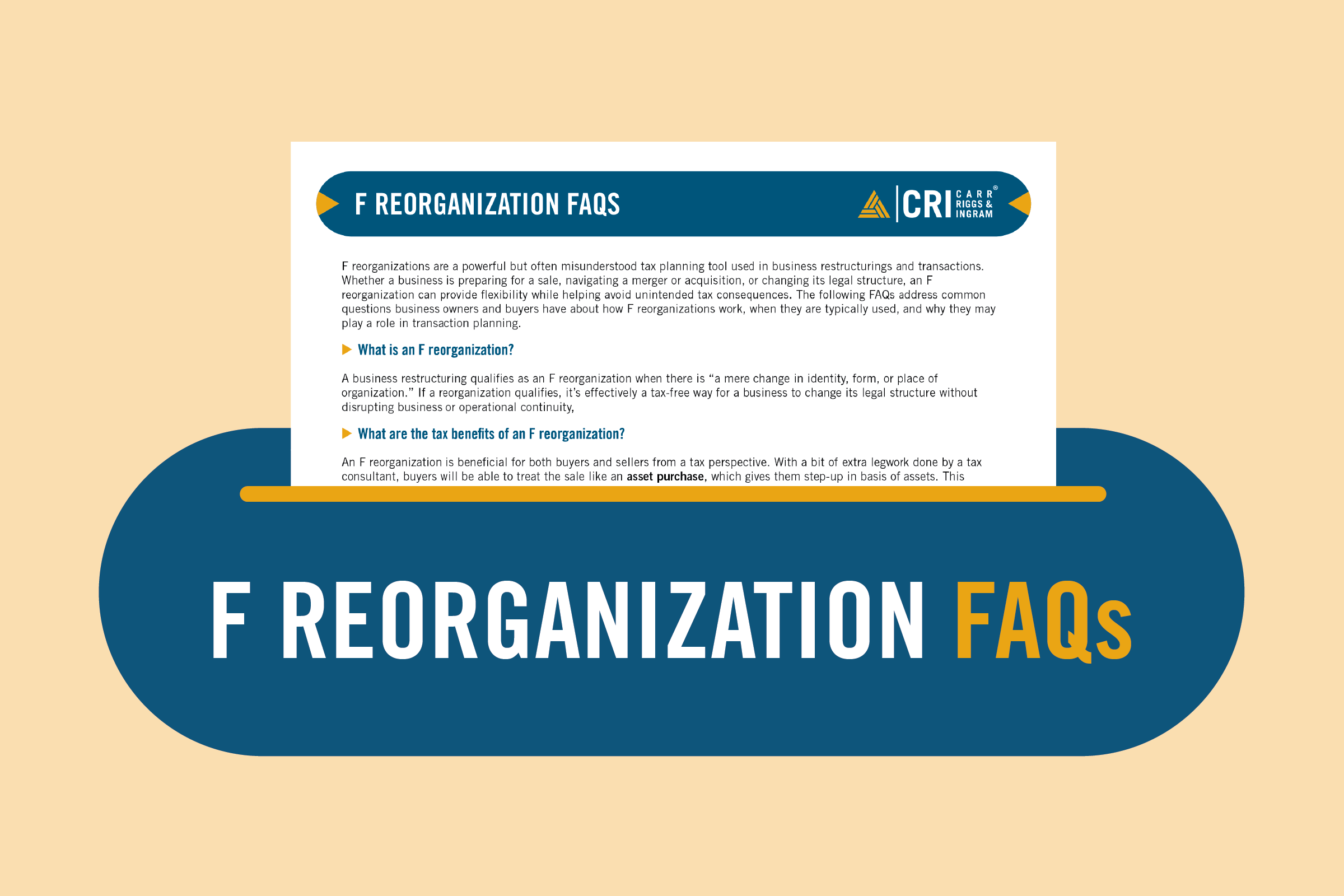
In our first article, F Reorganizations in M&A: What S-Corps Need to Know About this Winning Tax Strategy, we explained what an F reorganization is, how it works, and why it can be such a powerful tax planning tool. But that discussion focused primarily on the mechanics and theory behind F reorganizations.
In Part 2 of this series, we want to shift from theory to practice. We’ll walk through two real-world use cases — one quite simple, the other more complex — to demonstrate just how versatile these restructurings can be.
F Reorganization Use Case 1 (Simple)
Change of Tax Domicile
One simple, straightforward, and common use for F reorganizations is to change an entity’s tax domicile.
When business owners first form an entity, they often do so quickly, without fully considering how their state of incorporation could affect long-term strategy. But your tax and legal domiciles set the foundation for many important considerations, like:
- Corporate governance requirements
- Entity-level taxes
- Filing fees and franchise taxes
- Administrative and compliance complexity
- Financing and investment options
- Applicable corporate laws
As businesses grow and change, their original state of incorporation may no longer be the best fit. This is where F reorganizations can help.
An F reorganization helps a business change its state of incorporation withouttriggering a taxable event, and without disrupting underlying business operations. And that’s because the transaction is treated as a “mere change in identity, form, or place of organization” by the IRS.
Let’s look at an example.
Let’s assume long-time buddies Nia and Mark start a coffee roasting business in their home state of Ohio, which is also where they incorporate the company. Over the years, their footprint in the coffee industry grows. They begin supplying their beans to coffee shops in other states, and their long-term goals are to expand their own retail operations by opening company-owned coffee shops in several surrounding states.
To expand, Nia and Mark need to bring on additional investors. After talking with their advisors, they determine that being a Delaware business would better support their growth, in part because Delaware’s flexible and well-established corporate law can make it easier to issue equity and attract outside investors.
Instead of dissolving the entity and starting over, Nia and Mark use an F reorganization to change the company’s state of incorporation. They do this by:
- Forming a new Delaware holding company, structuring it so that ownership mirrors the existing Ohio corporation.
- Transferring their Ohio corporation stock to the new Delaware holding company in exchange for that holding company’s stock.
- Since the corporation had previously made an ‘S’ election for tax purposes, the new Delaware entity files a Qualified Subchapter S Subsidiary (QSub) election for the Ohio entity so that it is treated as a subsidiary of the holding company, disregarded for tax purposes.
- Continuing to operate the coffee business as they had before, now under the Delaware holding company structure.
As a result, Nia and Mark preserve their ownership interests, avoid a taxable restructuring, and can continue to operate the business without disruption. And because existing agreements with coffee shop partners and business licenses remain intact, they can focus their efforts on finding quality investors.
F Reorganization Use Case 2 (Complex)
M&A Transaction
A change in tax domicile is a simple yet effective use of an F reorganization. But F reorganizations can be used in more complex transactions, as well — especially when paired with other tax elections.
To dig a bit deeper, let’s continue with our previous example.
After Nia and Mark reorganized their business as a Delaware corporation, they took a step back on pursuing new investment. Even without new investors, though, they were able to grow their coffee business well beyond its original roasting operation. They continue to sell their beans at wholesale, and they’ve opened a few company-owned coffee shops across multiple states. The business has a strong brand, and their beans have been recognized at tasting events across the country.
Over the years, Nia and Mark have been approached by larger coffee roasters hoping to acquire their business, but they kept declining — the timing just never felt right. Today, they’re at a different stage in their lives, and they feel ready to move on from their coffee business. A larger coffee roaster they trust — one with capacity to support their wholesale business and continue operating existing retail locations — offered them a great price. They are ready to move forward with a sale.
At first, the transaction seems straightforward. But as negotiations begin, they realize that both parties want to approach the sale differently.
- Nia and Mark prefer a stock sale.
A stock sale would (1) let them recognize gain at favorable capital gains rates, (2) ensure the transaction would proceed efficiently, and (3) lead to a quick and painless exit from the business. - The buyer prefers an asset sale.
Structuring the transaction as an asset sale would give the buyer a step-up in the tax basis. With their newly acquired assets now having a basis at purchase price value, they could take larger depreciation deductions. Higher tax bases can also reduce taxable gains if they sell their assets — or their business as a whole — sometime in the future.
Fortunately, an F reorganization — when coupled with a Sec. 338(h)(10) election — can ensure both parties get what they want. Here’s how this type of transaction would work:
- Nia and Mark form a new holding company.
The holding company — let’s assume a Delaware corporation — mirrors their ownership of the coffee business. - The coffee business is placed under the holding company.
Nia and Mark transfer their shares of the coffee business to the holding company in exchange for its stock. This reorganization makes the coffee company a wholly owned subsidiary of the holding company. This qualifies as an F reorganization, so this restructuring triggers no tax consequences to Nia and Mark. - A QSub election is made for the coffee business.
The holding company makes a QSub election for the coffee company, ensuring the IRS treats the coffee company as a disregarded entity for federal tax purposes. - The buyer purchases coffee company stock.
The buyer purchases coffee company stock from the holding company, which — if you remember — is owned by Nia and Mark. Legally, this is a stock sale, which is what Nia and Mark prefer. - The parties make an election to treat the transaction as an asset sale.
Nia, Mark, and the buyer agree to make a Sec. 338(h)(10) election, which causes the stock sale to be treated as an asset sale. It’s as if the coffee company sold its assets at fair market value and then liquidated. This outcome is what the buyer prefers.
The Section 338(h)(10) election is most advantageous in scenarios where the target’s value is largely attributable to goodwill or other intangibles, as the buyer can amortize this goodwill over 15 years under Section 197. It is also particularly useful in the acquisition of service firms or government contractors, where continuity of contracts and relationships is critical. In leveraged buyouts, the increased depreciation and amortization deductions can help offset income from debt-financed acquisitions.
F Reorganizations Provide Flexibility
F reorganizations don’t change the economics of a transaction; they simply change its structure. Whether you’re considering a simple change or navigating a more complex transaction, an F reorganization can be a powerful planning tool. CRI’s M&A transaction advisory services knows how to leverage F reorganizations (and other tax elections) when they align with clients’ goals. If you’re considering a merger or acquisition — or if you’re simply evaluating your current entity structure — we encourage you to reach out. Early planning can make a meaningful difference in the outcome of your transaction.