
Real Estate Businesses Take Note: Rev. Proc. 2026-17 Lets You Revisit Section 163(j) Elections
- Contributor
- Debbie Alexander
Apr 27, 2026
Sometimes, simple procedural fixes can drive businesses to rethink their tax strategies entirely. Revenue Procedure 2026-17 is a prime example.
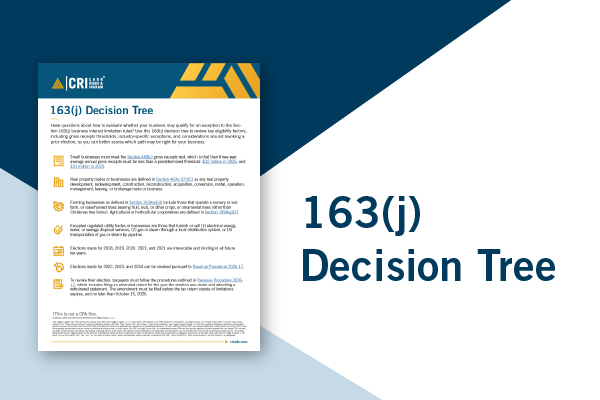
Rev. Proc. 2026-17 — released in March — does something quite simple: it lets taxpayers revoke Section 163(j) elections that were initially set to be binding for all future tax years. These elections exempted certain real estate and farming businesses from the Section 163(j) business interest deduction limitation.
At first glance, this seems counterintuitive. Why would a business want to revoke an election that lets it fully deduct business interest, without limitations?
The answer lies in how the tax landscape has shifted. The One Big Beautiful Bill Act (OBBBA) introduced changes that make Section 163(j) elections less attractive — and Rev. Proc. 2026-17 gives taxpayers the flexibility to revisit those decisions in light of these changes.
To understand this new opportunity, let’s answer two questions:
- Why did taxpayers make Section 163(j) elections in the first place?
- Why might they now want to revoke their elections?
Why did taxpayers make Section 163(j) elections in the first place?
Section 163(j) places a cap on the amount of business interest a taxpayer can deduct. This limitation generally applies to all taxpayers, with a few key exceptions:
- Small businesses — i.e., those with average gross receipts below a certain threshold ($31 million for 2025; $32 million for 2026)
- Certain utility trades or businesses
- Real estate businesses that make a certain election
- Farming businesses that make a certain election
For real estate and farming businesses, the Section163(j) limitation can be quite harsh. These industries tend to rely heavily on debt financing, resulting in high interest expenses. Limiting those deductions could noticeably increase their tax liability.
To address this, the tax law lets these taxpayers elect out of Section 163(j) altogether. Businesses that elect to be treated as an “electing real property trade or business” or an “electing farming business” will not be subject to Section 163(j) limitations and can fully deduct business interest expenses in the year they were incurred.
Why might they now want to revoke their elections?
Being able to fully deduct interest expenses is a lifesaver for real estate and farming businesses — but it comes at a cost: the loss of bonus and accelerated depreciation.
Businesses that make a Section 163(j) election are required to depreciate assets using the Alternative Depreciation System (ADS) rather than the General Depreciation System (GDS). Since bonus and accelerated depreciation are only available under the GDS, these businesses must forego accelerated depreciation and use only straight-line depreciation on qualifying asset purchases.
In other words, these taxpayers can either (1) fully deduct interest expense, or (2) claim bonus depreciation — but not both.
Before the OBBBA was passed, this wasn’t a huge concern — bonus depreciation was scheduled to be fully phased out by 2027. But when Congress passed the OBBBA on July 4, 2025, it reinstated 100% bonus depreciation and made it a permanent option for all future tax years.
This created a dilemma for electing real property and farming businesses. At the time they made those elections, the bonus depreciation tradeoff was less significant. But once the OBBBA put bonus back on the table, their reality changed. The elections that made sense under the prior tax landscape may no longer produce the more favorable tax outcome under the OBBBA.
Rev. Proc. 2026-17 gives taxpayers the chance to revoke their elections.
Taxpayers have to ask themselves: does the benefit of fully deducting business interest expense outweigh the cost of forgoing bonus depreciation?
Should you revoke your Section 163(j) election?
There are a few key things to remember when you’re determining if you should take advantage of Rev. Proc. 2026-17 and revoke your election:
- Interest limitations are less restrictive than in prior years.
Business interest deductions are generally limited to 30% of adjusted taxable income (ATI). Beginning in 2025, the ATI calculation is more favorable, which may reduce the impact of the limitation compared to prior years. - Bonus depreciation doesn’t generate larger deductions; it simply accelerates them.
Bonus depreciation is ultimately a timing benefit; it lets you take deductions now rather than spreading them out over time. This could benefit you. For example, if you know you’ll be making high-cost purchases soon, bonus depreciation can help you recoup those costs much more quickly, which can improve near-term cash flow. - Disallowed interest expenses aren’t lost; they’re carried forward.
Interest expense deductions limited under Section 163(j) are carried forward indefinitely. But be honest with yourself: how likely is it that you’ll have sufficient ATI to use those carryforwards in the future? - The opportunity to revoke your election is limited.
While Rev. Proc. 2026-17 provides flexibility to revoke prior elections, the underlying election remains binding going forward. If you don’t act now, you may not have another opportunity to revisit your decision. Amended returns must be filed by the earlier of (a) October 15, 2026, or (b) the date the statute of limitations expires for the year to be amended. - Consider the cost to amend prior year returns.
If you choose to revoke your Section 163(j) elections, you likely need to amend prior year returns to reflect that change. The administrative costs and reporting complexities are worth consideration.
Evaluate the Tradeoffs Before Revoking Your Election
Rev. Proc. 2026-17 gives certain real estate and farming businesses a valuable opportunity to revisit prior Section 163(j) elections, but revocation should be evaluated carefully. The potential benefit of restored bonus depreciation should be weighed against business interest limitations, cash flow needs, amended return requirements, and long-term tax planning goals. Contact your CRI advisor to discuss whether revoking a prior election may be beneficial for your business. Taking time to model the impact now can help you make a more informed decision before the available relief window closes.