
Did Interest Just Get Cheaper? How the OBBBA Restores Interest Deductions Under Section 163(j)
- Contributor
- Debbie Alexander
Mar 18, 2026
Section 163(j) is a provision in the tax code that limits the amount of interest businesses can deduct — and it has become more restrictive in recent years. Even though businesses were borrowing more money than ever, their interest deductions were shrinking, all thanks to Section 163(j). But a provision in the One Big Beautiful Bill Act (OBBBA) might be the light at the end of the tunnel.
Section 163(j): A Brief Overview
Section 163(j) has been part of the tax code for decades, but it used to be a niche rule that affected only large multinational corporations. Today, it applies to nearly all taxpayers by limiting the amount of interest expense they can deduct.
Today, business interest expense deductions are limited to the sum of:
- Business interest income;
- 30% of adjusted taxable income (ATI)*; and
- Floor plan financing interest.
Any disallowed deductions can be carried forward indefinitely.
* Your adjusted gross income (AGI) is your total (gross) income from all sources minus certain adjustments listed on Schedule 1 of Form 1040. Your AGI is calculated before you take your standard or itemized deduction on Form 1040.
Exceptions:
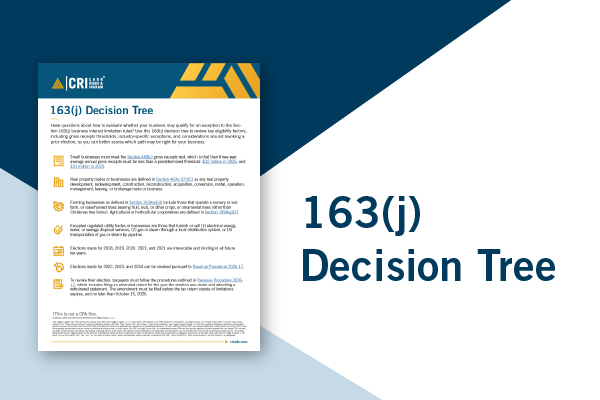
Two types of entities are exempt from Section 163(j):
- Small businesses whose average annual gross receipts over the last three years are $31 million or less (in 2025; indexed annually for inflation)
- Real estate businesses that make a certain election
How Section 163(j) Changed Prior to the OBBBA
The business interest limitation has undergone several transformations even before the OBBBA was passed — some good, some bad. Let’s review the timeline of these changes:
Pre-2018: The Golden Era
Before 2018, there were very few limits: the interest you paid is what you could deduct. In general, only large, multinational entities saw their interest deductions being capped.
2018: The New Normal
Effective in 2018, the Tax Cuts and Jobs Act (TCJA) expanded the Section 163(j) limitation. Instead of affecting only large multinational entities, it expanded to nearly all taxpayers.
Additionally, the TCJA implemented a tiered phase-in of how ATI is calculated. From 2018 through the end of 2021, ATI was calculated similarly to EBITDA: earnings without regard to Interest, Taxes, Depreciation, and Amortization (or depletion). But starting in 2022, ATI was to be calculated similarly to EBIT. This small change would have made most taxpayers’ ATIs smaller starting in 2022, which in turn would shrink their potential interest deduction.
…then the pandemic hit.
2019-2020: The Pandemic Lifeboat
In response to the coronavirus pandemic, Congress used the CARES Act to throw a lifeline to leveraged businesses. It did this in a few different ways, but the most noteworthy was that it boosted the ATI limitation from 30% to 50%. Taxpayers that were eligible and made the election could use the larger 50% limit retroactive to 2019 and for 2020 (though partnerships were only eligible in 2020).
2021: Back to Basics
In 2021, 50% ATI limitation expired, reverting the ATI calculation back to what was first introduced in the CARES Act: 30% of ATI, which was calculated similarly to EBITDA.
2022-2024: The Dark Years
In 2022, the TCJA’s tiered ATI calculation finally phased in: it shifted from the taxpayer-friendly EBITDA to the taxpayer-unfriendly EBIT. Reducing earnings by depreciation, amortization, and depletion often resulted in a smaller ATI, which led to a smaller interest deduction. The EBIT ATI calculation was to continue for years into the future — but the OBBBA made yet another change.
How the OBBBA Changed Section 163(j)
The OBBBA was written into law on July 4, 2025. It made two taxpayer-friendly changes, both effective in 2025, and two less favorable changes, both effective in 2026.
The Good Changes
- Permanently restores the EBITDA ATI calculation.
Starting in 2025, taxpayers can once again add back deductions for depreciation, amortization, and depletion when calculating ATI. Returning to the EBITDA calculation of ATI increases the amount of deductible interest for most taxpayers, especially those buying and using high-value assets. - Expands the definition of floor plan financing interest.
Starting in 2025, the floor plan financing interest calculation now includes amounts for trailers or campers, as long as those trailers or campers were built to be used as temporary living quarters (like when camping) and designed to be towed behind a vehicle.
The Bad Changes
- Changes the definition of interest expense.
The law clarified that business interest expense would include all interest paid or accrued, even if the taxpayer would not have otherwise deducted that interest because of an elective or mandatory interest capitalization provision. Starting in 2026, this effectively removes the benefit taxpayers would get from electively capitalizing interest expenses. - Excludes Subpart F and GILTI from ATI.
Starting in 2026, ATI excludes Subpart F income, GILTI inclusions, and other amounts that typically impact entities with controlled foreign corporations (CFCs). These changes to the ATI calculations could negate the benefit of the expanded EBITDA ATI calculation for affected entities.
What Taxpayers Should Expect
For taxpayerssubject to Section 163(j), the OBBBA’s changes could lower your tax bill in the next few years. Reverting the ATI calculation from EBIT to EBITDA is a boon for businesses with high levels of depreciation and amortization, making it likely their deduction cap will rise compared to what it was in 2024. Entities with CFC activity or those that choose to capitalize interest expense might need to perform additional calculations to see if they’ll come out on top — it’s possible the changes will be a wash.
But we also want to remind you that you may not be affected by the Section 163(j) changes at all. If your business is small enough to meet the gross receipts test, or if you’re a real estate business that makes a certain election, you won’t be subject to the Section 163(j) limitation — at all.
Reach out to your CRI Advisor to discuss how Section 163(j) could affect your tax planning for 2025 and 2026.