
New Clarity on Micro Captives: Court Limits IRS Authority on Listed Transactions
- Contributors
- Rachel Q. Hogston
- Scott Bailey
Apr 29, 2026
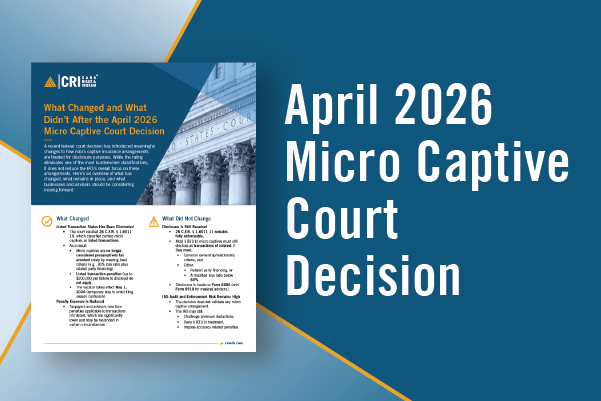
A recent federal court decision has reshaped the regulatory landscape for micro captive insurance arrangements, providing both clarity and continued uncertainty for taxpayers. In its April 15, 2026, memorandum opinion, the court addressed whether the Internal Revenue Service (IRS) acted within its authority when issuing new disclosure requirements for these transactions. While part of the IRS’s framework was upheld, another portion was struck down, creating important implications for reporting obligations, compliance risk, and how businesses evaluate their captive structures moving forward.
Overview of the Case and Key Court Holdings
The Drake Plastics Ltd. Co. et. al. vs Internal Revenue Service case addresses whether the Internal Revenue Service (IRS) lawfully required disclosure of certain micro‑captive insurance transactions under new Treasury regulations issued in January 2025. Micro‑captives are small, closely held insurance companies that elect favorable tax treatment under Internal Revenue Code § 831(b). While many are legitimate, the IRS has long viewed some as potential vehicles for tax avoidance.
Under its final regulations issued in January, 2025 (Final Regs), the regulations created thresholds for treatment of certain microcaptive transactions as “transactions of interest” or “listed transactions” based on average loss ratios and potential “financing factors.” For reference, the IRS defines these transaction types as follows:
- Transactions of Interest (26 C.F.R. § 1.6011‑11): transactions that have a potential for tax avoidance or evasion.
- Listed Transactions (26 C.F.R. § 1.6011‑10): transactions deemed presumptively tax‑avoidant, triggering the most severe penalties for failure to disclose (i.e. abusive more often than not).
Plaintiffs—an operating company, its captive insurer, and a captive insurance advisor—challenged both rules under the Administrative Procedure Act (APA), arguing that the IRS exceeded its statutory authority and acted arbitrarily and capriciously.
Court’s Holdings
The court issued a split decision:
- Transactions of Interest Upheld
The court held that the IRS acted within its authority in designating certain micro‑captive arrangements as “transactions of interest.” Congress granted the IRS broad power to require reporting of transactions that may have a potential for tax avoidance. The IRS relied on precedent from several high-profile captive tax court cases showing that some micro‑captive arrangements fail to meet the definition of insurance under the Internal Revenue Code and relevant case law. The court also found that the criteria utilized by the IRS in the Final Regs justified—such as ownership relationships, related‑party financing, and loss ratios. - Listed Transactions Vacated
The court determined the IRS exceeded its authority by classifying micro‑captive transactions as “listed transactions.” The court was not convinced that the evidence in the administrative record demonstrated that most transactions captured by the listed‑transaction rule were actually tax‑avoidant. While the IRS could identify common characteristics of abusive transactions but failed to show that those characteristics could reliably distinguished them from legitimate transactions. As a result, the IRS could not display the higher standard of evidence required to determine these transactions were presumptively tax-avoidant.
Remedy
While 26 C.F.R. § 1.6011‑11 remained intact (transactions of interest), the court and vacated 26 C.F.R. § 1.6011‑10 (listed transactions). The vacatur of the listed‑transaction rule was stayed until May 1, 2026, to prevent taxpayer confusion during the filing season.
What This Means for Taxpayers
While vacating the listed transaction rule potentially reduces certain disclosure and penalty risks, reporting obligations and IRS scrutiny remain in place under the “transactions of interest” designation. This is not a relaxation of oversight, but a reminder of the importance of proper structuring, documentation, and compliance.
Additionally, this court ruling occurred at the district court level (specifically, the Southern District of Houston). As such, how the change in federal regulations will affect their consideration nation-wide is yet to be determined.
If you need help evaluating how this decision may affect your organization, assessing your current captive structure, or identifying any needed adjustments to your reporting or compliance approach, CRI can help. Contact your CRI advisor to discuss your situation and any questions you may have. Taking a proactive approach now can help position your organization to navigate continued scrutiny with greater confidence.