
Estate Tax Planning After the OBBBA: What High-Net-Worth Families Should Revisit in 2026
- Contributor
- Sarah Freeman
Feb 23, 2026
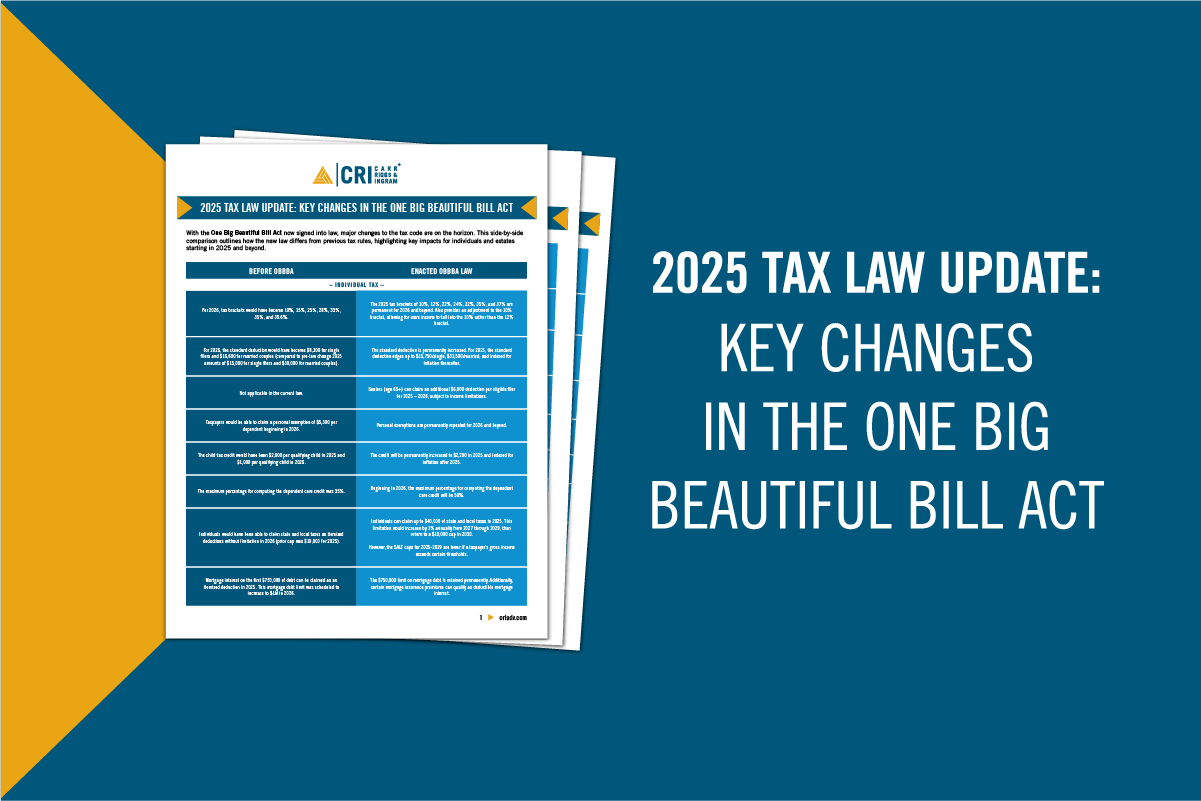
After decades of uncertainty around the estate tax, the One Big Beautiful Bill Act (OBBBA) made the $15 million exemption permanent. But that’s far from the only change the legislation introduced. The OBBBA revised a wide range of provisions that could impact business owners and high-net-worth taxpayers. Let’s talk about how these changes will affect their estate and income tax plans in 2026 and years into the future.
Estate Tax Exemption
The OBBBA raised the federal estate tax exemption to $15 million per person ($30 million for married couples) starting in 2026. This is an increase from $13.99 million in 2025. And bonus: going forward, this $15 million exemption will be indexed for inflation.
What does this mean for tax planning?
Statistically, very few taxpayers will pay estate tax. In 2023, approximately 7,100 estate tax returns were filed, and only 4,000 of those were taxable[1] — which represents fewer than .2% of taxpayers that passed away that year.
But that doesn’t mean the exemption is irrelevant.
In many cases, taxpayers avoid paying estate taxes because they created and followed a thoughtful tax plan over many years or decades leading up to their death. Now that this larger exemption has no expiration date, building that tax plan gets a lot easier. Yes, a new administration could introduce new legislation that changes the tax code, but as it’s written, the larger exemption is here to stay. This gives you more flexibility when building your estate plan.
529 Plans
The OBBBA changed a few things about 529 plans that made them more useful as a planning tool:
- Taxpayers can now withdraw up to $20,000 to use on K-12 expenses (up from $10,000 in 2025).
- Funds withdrawn for K-12 expenses can now be used for curriculum materials, standardized testing fees, dual enrollment courses for high school students, online educational programs, and tutoring and other services for students with disabilities.
- Credentialling programs (like a CPA exam course or a course to get an advanced nursing degree) are now eligible expenses. This includes the tuition for these programs, but also books, exams, and supplies.
- The OBBBA made tax-free rollovers from 529 plans to ABLE accounts permanent.
What does this mean for tax planning?
529 plans are no longer just for college planning; they’re a financial planning tool to support education and learning throughout someone’s lifetime. They can be used:
- While your kids are in school
- To help your kids obtain career credentials or licensure
- To help pay down student loans
- Make a new degree or certification affordable for you
And because of their crossover with ABLE accounts, they are especially useful for families with disabled children or dependents.
Trump Accounts
The OBBBA established a new tax-advantaged investment vehicle for children called Trump Accounts. If you have children under 18, you can open an account for their benefit, with you as custodian. If your children were born in 2025, 2026, 2027, or 2028, the government will help fund their accounts with a one-time $1,000 investment per child.
Combined, you, your child, other family members, and your employer can contribute up to $5,000 per year to each child’s account until they turn 18 (though employer contributions are limited to $2,500 per year). Once your child turns 18, the account is treated more like a traditional IRA, where your child becomes the sole contributor and owner of the account.
Contributions and earnings grow tax-deferred. If the funds are kept in the account until retirement age, they can be used for any purpose. Withdrawals made before that would be subject to penalties unless funds are used for one of the known exceptions, like to purchase a first-time home.
What does this mean for tax planning?
For high-net-worth families, Trump accounts are a simple way to transfer wealth to younger generations. Annual contributions are treated as gifts, which helps parents use up annual gift tax exclusion amounts (which are $19,000 per person in 2026) without opening complex (and potentially administratively costly) trusts or custodial accounts. If these other accounts already exist, they can be used to complement those tax strategies, simply providing another layer of wealth accumulation and early retirement planning for kids.
SALT Deduction Cap
The OBBBA temporarily increased the state and local tax (SALT) deduction cap from $10,000 to $40,000 in 2025. Starting this year, the cap is adjusted upward by 1% each year through 2029. In 2030, the deduction cap drops back down to $10,000.
What does this mean for tax planning?
Though this appears to be a significant benefit, many high-net-worth individuals may not qualify for the full expanded deduction. The increased cap begins to phase down for taxpayers with modified adjusted gross income (MAGI) over a certain threshold — $500,000 in 2025.
However, taxpayers whose MAGI is near that threshold may still benefit from partial relief. Larger SALT deductions, even for just the next few years, can provide significant tax savings.
It’s also good to keep this new SALT deduction cap in mind when deciding whether to elect into pass-through entity taxes. We discuss how PTETs might play into the SALT deduction cap here.
Charitable Contribution Deductions
Tax deductions for charitable contributions are changing under the OBBBA. Starting in 2026, individuals who make charitable contributions must reduce their deduction by .5% of their adjusted gross income (AGI). In addition to this new .5% AGI floor, individuals still cannot take a deduction for contributions that exceed 50% of their AGI (or 60% for cash contributions).
Corporations face a similar limitation. Beginning in 2026, corporate taxpayers can only deduct charitable contributions that exceed 1% of their taxable income for that year.
What does this mean for tax planning?
These new deduction floors effectively eliminate the tax benefit of making smaller charitable donations, especially for taxpayers who report high earnings. There are ways to help mitigate this effect, like using donor advised funds or establishing multi-year donation plans that incorporate bunching techniques. But each solution is unique, so it’s important to work with an advisor to come up with a giving strategy.
Qualified Small Business Stock (QSBS) Gain Exclusion
The OBBBA made the qualified small business stock (QSBS) gain exclusion even more powerful.
Under Section 1202 of the tax code, eligible investors can exclude up to 100% of the gain recognized from the sale of QSBS that they hold for at least five years. The OBBBA enhanced the exclusion by:
- Making it easier for investors to qualify
- Raising the exclusion cap
- Allowing for partial exclusions if stock is held for less than five years
What does this mean for tax planning?
We go into detail about these changes here. But at a high level, these changes make early-stage investments more attractive from a tax perspective. It’s easier to qualify and easier to get even a partial exclusion, so investing in qualified small businesses will be more attractive moving forward. If you’ve struggled to qualify for the QSBS exclusion in the past, it’s worth revisiting in 2026.
Planning for Tax Year 2026 and Beyond
As 2026 approaches, high-net-worth families and business owners should revisit their estate and income tax strategies in light of these legislative changes. Proactive planning can help align your wealth transfer goals with evolving tax rules and identify opportunities to strengthen your overall financial strategy. To discuss how these updates may affect your situation, contact your CRI advisor for guidance tailored to your long-term planning objectives. Early coordination can help you make informed decisions and position your plan for the years ahead.