
Is Now the Time To Revisit Your Entity Structure?
- Contributor
- Gary Pharr
Jun 29, 2026
The One Big Beautiful Bill Act (OBBBA) is our latest reminder that entity choice shouldn’t be viewed as permanent.
When you first started your business, you and your advisors evaluated several factors to determine how your entity should be structured. Likely, you discussed things like:
- Liability protection
- Owners’ tax and succession goals
- Federal and state tax laws and incentives
- Expected growth trajectory
- Availability of financing
- Likelihood of a sale, acquisition, or merger
But since you made that choice, the world changed — the economy, tax laws, and potentially even your goals. This raises an important question: When was the last time you revisited your entity structure?
Why Entity Choice Deserves a Second Look
Over time, tax laws change — sometimes significantly. We’ve seen this firsthand in recent years. In the past decade alone, several major pieces of tax legislation have been enacted, interpreted, and refined through subsequent guidance, including:
- The Tax Cuts and Jobs Act (2017)
- The CARES Act (2020)
- The Inflation Reduction Act (2022)
- The One Big Beautiful Bill Act (2025)
These tax laws have modified existing rules, repealed others, and introduced brand-new incentives. Some of the conclusions you reached years ago may not hold up in today’s tax landscape.
We don’t want this article to encourage change for the sake of change. But we encourage you to challenge your longest-held assumptions — like your preference in entity structure — so that you can be confident in your tax strategy today.
What Has Changed Since You Settled on a Tax Structure for Your Business?
It’s rarely one single law change that makes you question your entity structure. But the cumulative effect of multiple tax law changes can build a strong case for making a change. The following four examples are not an exhaustive list, but they illustrate how changes in the tax code can affect the assumptions behind your original choice.
Corporate Tax Rate Reduction
Starting in 2018, the highest corporate tax rate was permanently reduced from 35% to 21%. This was significant on its own, but its implications went beyond just lowering a company’s annual tax bill.
The rate reduction fundamentally changed the entity choice conversation. For years, many business owners had dismissed C corporations because of their relatively high tax rates. With the corporate rate reduced to 21%, that assumption no longer held true, and business owners were forced to reevaluate the advantages and disadvantages of each entity type. In many cases, factors such as growth plans, financing needs, exit strategies, and ownership goals suddenly carried more weight.
Qualified Business Income Deduction (Section 199A)
The TCJA didn’t just help corporations. It also created new opportunities for pass-through entities, including the Qualified Business Income (QBI) deduction.
When the TCJA dropped the corporate tax rate from 35% to 21%, there was concern that pass-through businesses would be at a disadvantage since many individual income tax rates remained higher than the new corporate rate. The QBI deduction was designed, in part, to narrow that gap.
Often referred to as the pass-through entity deduction, the QBI deduction lets owners of pass-through businesses (S corporations, partnerships, and sole proprietorships) deduct up to 20% of business income.
The deduction didn’t create perfect parity between pass-through entities and C corporations, but it helped preserve the competitiveness of pass-through structures. However, when it was initially enacted, the deduction was only temporary. It was set to expire after December 31, 2025, creating uncertainty about its long-term value.
The OBBBA made the deduction permanent, which removed much of this uncertainty. For many business owners, this reinforces the long-term viability of pass-through structures and may have altered the assumptions underlying their prior entity choice decisions.
Qualified Small Business Stock Gain Exclusion (Section 1202)
For years, many business owners dismissed C corporations because of concerns about double taxation. While that concern remains valid, recent changes to the qualified small business stock (QSBS) rules may make C corporations more compelling.
The QSBS gain exclusion lets eligible investors exclude up to 100% of the taxable gain recognized from the sale of qualifying small business stock. The OBBBA expanded aspects of the QSBS rules , making it easier to qualify and increasing potential tax savings.
The catch is that QSBS benefits are generally only available to shareholders of C corporations. Business owners who had previously dismissed the C corporation structure now have incentive to rethink their decisions, particularly if they anticipate their stock will significantly appreciate or if they plan to sell the business in the foreseeable future.
In some cases, restructuring can help a business take advantage of QSBS opportunities while preserving certain benefits traditionally associated with pass-through entities. This is a good reminder that entity planning is rarely a this-or-that selection; the right structure can involve multiple entities working together to support both tax efficiency and business goals.
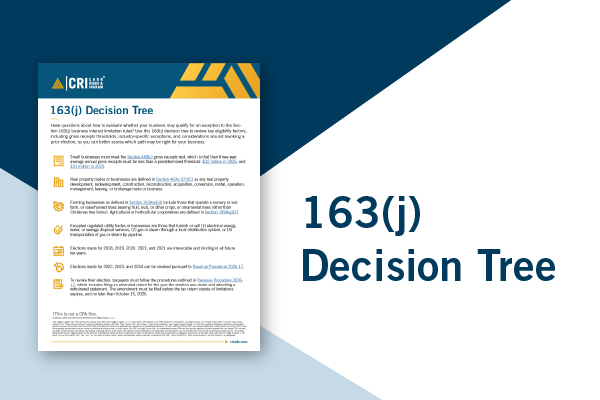
Section 163(j) Changes
The TCJA introduced a new provision that restricts the amount of business interest taxpayers can deduct each year. Since its enactment, it has been modified multiple times through legislation and administrative guidance, which created a moving target for businesses that rely heavily on debt financing.
Let’s look at real estate businesses: these businesses initially had the opportunity to elect out of Section 163(j). Lawmakers recognized that real estate businesses are unusually dependent on debt financing, and such a strict limitation could disproportionately harm the industry. The trade-off was that taxpayers making the election had to forgo the use of bonus depreciation.
But administrative guidance released in early 2026 provided taxpayers with an opportunity to revoke that election to take advantage of renewed bonus depreciation opportunities.
So, what does all of this have to do with entity selection?
When business owners evaluate entity structure, financing needs are often part of that conversation. Changes to the tax treatment of debt, like those we’ve seen with Section 163(j), can affect many aspects of the business — cash flow, growth strategy, investment decisions, exit timing, and more. A business that selected its entity structure based on the financing realities that existed when Section 163(j) was first enacted may find that today’s rules warrant a fresh look at that decision.
Revisit Your Entity Structure as Your Business Evolves
The best entity structure is not necessarily the one you chose years ago. Choosing an entity structure is one of the most important decisions business owners make, but it should not be a “set it and forget it” decision. As tax laws, economic conditions, ownership goals, and business operations evolve, it may be both reasonable and prudent to revisit decisions made years ago.
You may ultimately conclude that your current structure is still the best fit. However, the review process can provide valuable clarity and help confirm whether your business remains aligned with your long-term goals. Contact your CRI advisor to discuss your current entity structure and evaluate whether a change may be beneficial for your tax position, operational needs, and future plans.