
Five Lessons Learned from Implementing GASB Statement 103
- Contributors
- Becky Hammond
- Dean Michael Mead
Aug 7, 2026
Beginning with fiscal years ending June 30, 2026 and later, cities, counties, school districts, public colleges, utilities, and other state and local governments are required to apply Governmental Accounting Standards Board (GASB) Statement No. 103, Financial Reporting Model Improvements. Governments will need to invest significant time understanding the standard’s requirements and preparing for implementation.
Since the standards were issued in 2024, the governmental accounting experts at Carr, Riggs & Ingram (CRI) have helped clients understand and implement Statement 103. Five lessons CRI and our clients have learned so far can help governments use their time effectively and successfully achieve compliance.
Statement 103 in Brief
The GASB is requiring governments to improve certain features of the financial reporting model—essentially, the blueprint and contents of the annual audited financial report.
Those improvements include:
- Making management’s discussion and analysis (MD&A), the narrative section that precedes the financial statements, more informative and readable by:
- Targeting a reader with no prior knowledge of governmental accounting.
- Focusing on explaining why finances changed during the year, not merely the amount they changed.
- Replacing unnecessary repetition of explanations with references to other parts of MD&A.
- Clarifying the required contents of the sections on capital asset and long-term financing activity and currently known facts, conditions, or decisions.
- Simplifying the reporting of uncommon revenues and expenses by replacing extraordinary items and special items with a single category of unusual or infrequent items.
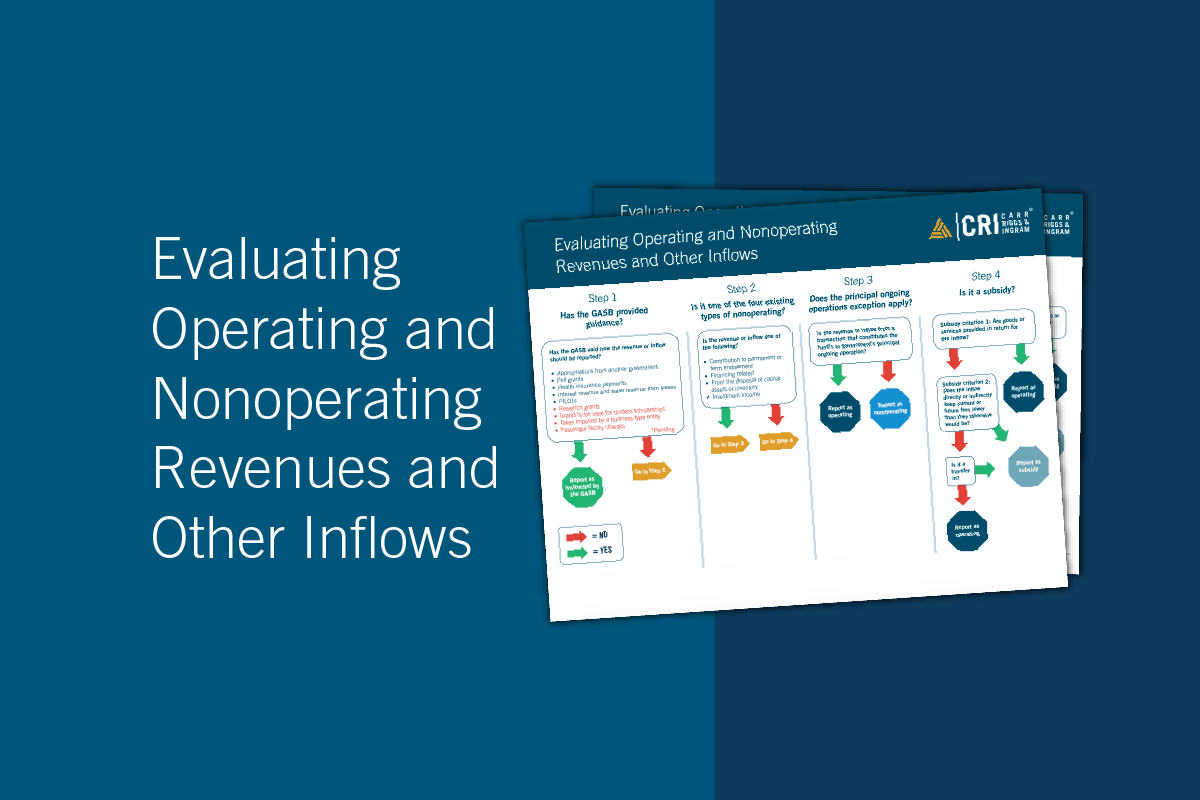
- Establishing definitions of operating and nonoperating revenues and expenses, including subsidies as a type of nonoperating.
- Adding a new section for noncapital subsidies and “operating income (loss) and noncapital subsidies” to the proprietary funds statement of revenues, expenses, and changes in fund net position.
- Moving the budgetary comparison to required supplementary information (RSI) for all governments, requiring columns showing the variances between original and final budgets and the final budget and actual results, and adding a note explaining the significant variances.
- Requiring that major component units be shown individually on the face of the government-wide financial statements, as long as doing so does not diminish their readability, or in combining financial statements.
- Adapting the statistical section schedule of changes in net position to reflect the revisions made to the proprietary funds statement.
For a deeper dive into the requirements of Statement 103, check out this webinar hosted by CRI and this article.
Lesson 1: Work may be needed before you can start implementing Statement 103
One reason the GASB issues new standards is that governments may be having difficulty with the existing standards or are applying them differently from their intended purpose. So it shouldn’t be a surprise that governments sometimes have to catch up with what was already required before they can begin applying the new requirements. For example, some governments:
- Include an analysis of the government-wide statements in MD&A but not a fund-level analysis, although both are required;
- Report the amounts of capital assets and outstanding debt they have but do not discuss significant activity during the year; or
- Fail to prepare MD&A at all.
The implementation effort necessary for governments with those shortcomings will be greater than that for governments that fully met the prior requirements.
Lesson 2: You may need to drill down to explain why something changed
Statement 103’s emphasis on explaining why financial position or results of operations changed is not new; the prior standards also required it. However, some governments reported how much assets, revenues, and other items changed without explaining why. And that really is the point of MD&A: to discuss and analyze, to tell the reader things they otherwise wouldn’t know just from looking at the numbers.
Fully explaining why changes happened may be challenging because the reasons aren’t always immediately obvious. Like a child questioning a parent, you may need to ask “Why?” several times to get to the most meaningful answer.
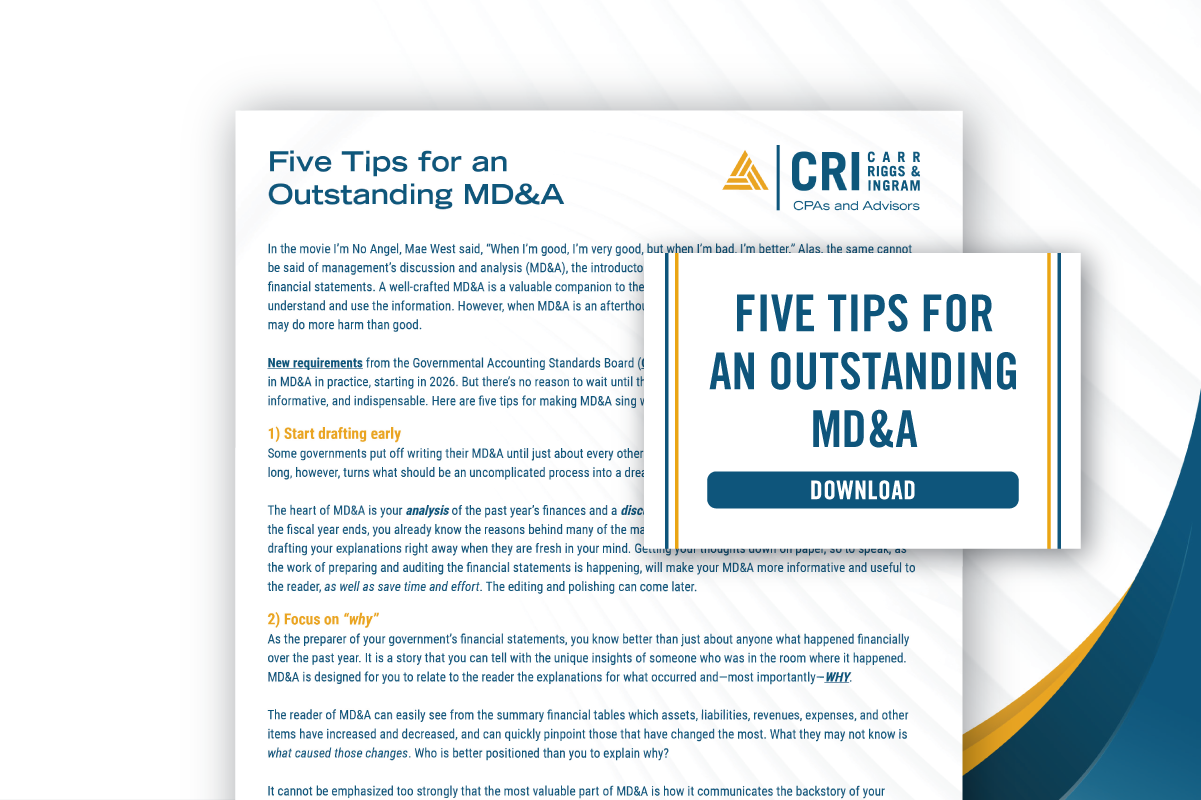
For example, if tax revenues increased significantly more than other revenue sources, stating in MD&A that it was because property tax revenues rose 10 percent is probably not sufficient. Why did property taxes go up? Perhaps the answer is a combination of an increase in the tax rate and rising property values. The reasons why the city council increased the rates and why property values are rising may be important parts of the explanation you include in MD&A as well. Try to imagine yourself as the reader and ask whether you would be satisfied with the explanation you have written. (For more tips on preparing an effective MD&A, see this article.)
Lesson 3: You will need to make some judgment calls
Implementation may be easier when the GASB tells us explicitly what to do. However, several provisions of Statement 103 require governments to use their professional judgment to determine how best to comply. In other words, the precise requirement may not be black and white. Governments may need to lean on their experience, knowledge, and particular circumstances when applying the standards.
Several aspects of Statement 103 require governments to determine what is “significant.” In MD&A alone, governments must explain all significant changes to financial position and results of operations for governmental and business-type activities, all significant financial changes in major funds, significant capital asset activity, and significant long-term financing activity. The budgetary comparison must also include a note explaining significant variances.
To determine what is significant, governments should consider what information would be meaningful to readers and could influence their understanding of the government’s financial position or results of operations. Stated differently, what information, if not included, could result in the readers drawing incorrect conclusions?
Lesson 4: Ignore GASB implementation guidance at your peril
The GASB’s question-and-answer guidance published in its Implementation Guides is authoritative. That means governments are required to comply with them, just as with Statements. Statement 103 made major changes to some existing Q&As, and the GASB subsequently issued new Q&As in June 2025 that must be implemented at the same time as the Statement. Briefly:
- Pell Grant revenue should now be reported as operating, not nonoperating.
- Appropriation aid, such as what state governments provide to their public colleges and universities, should be reported as a subsidy.
- Payments received from third-party insurers to pay for services provided to patients are not subsidies.
- Lease-related interest revenue reported by a government that is a lessor is nonoperating, even if the government’s principal ongoing operation is leasing
- The revenue a lessor reports from amortizing the deferred inflow of resources is operating.
- Whether a subsidy is considered noncapital depends on whether the provider of the resources states it must be used for capital purposes, not on how the government uses the resources.
- Component units with different fiscal year-ends from those of their primary government are required to implement the Statement earlier so they can be incorporated into the primary government’s financial statements.
In 2026, the GASB proposed additional Q&As related to subsidies and expects to publish the final guidance later this year. The proposed Q&As tentatively conclude that taxes imposed by BTAs, donations received by colleges and universities for student scholarships, and passenger facility charges received by airports are subsidies. They also explain that research grants may qualify as subsidies depending on the substance of the transaction and clarify that capital subsidies should be reported as other nonoperating revenues and expenses.
Lesson 5: Implementing Statement 103 does not have to be a solo journey
Applying the new standards does not oblige governments to reinvent the wheel or figure it all out on their own. There is a wealth of educational material available from CRI and others to help you get caught up on what Statement 103 requires. CRI will be conducting another webinar on August 27, 2026, to further explore these and other lessons learned as we have worked with clients on Statement 103 implementation.
Prepare for Statement 103 with Experienced Guidance
CRI’s governmental accounting experts bring substantial experience helping governments prepare for and implement Statement 103, including insights from a partner who spent 24 years on the GASB staff and helped develop the standards. Our services range from providing general training and technical support to evaluating a government’s existing reporting and developing an implementation plan and assisting with or performing the implementation activities. Contact your CRI advisor to discuss how we can help your government successfully achieve full compliance with Statement 103.