
What Are Deferrals, Where Did They Come From, and Why Are They Important?
- Contributor
- Dean Michael Mead
Sep 14, 2026
State and local governments have their own body of accounting and financial reporting standards, established by the Governmental Accounting Standards Board (GASB) and separate from the standards established by the Financial Accounting Standards Board (FASB) for companies and nongovernmental not-for-profits (NFPs). Nevertheless, many provisions of those two sets of standards are identical. For instance, when an employee works and earns a salary, it results in the reporting of salaries payable and salaries expense no matter what type of entity the employer is.
When the generally accepted accounting principles (GAAP) established by the GASB and the FASB differ, the disparity is sometimes considerable. There may be no better example of this than the GASB requirement to report deferred outflows of resources and deferred inflows of resources (together, deferrals), which are unique to state and local governments. To people familiar only with corporate or NFP financial statements, the appearance of deferrals in government financial statements is a strange new concept, one that they often have difficulty understanding and that even experienced governmental accountants have trouble explaining.
Deferrals do not have to be confusing. Though unfamiliar to some, deferrals are an essential aspect of governmental accounting and communicate important information about a government’s financial health. This article, adapted from a recorded presentation, is intended to help clear the fog that surrounds deferrals by explaining:
- What deferrals are and how they differ from other items in financial statements like assets and expenses
- How deferrals arrived in governmental financial statements in the first place
- Why deferrals are important
What Are Deferrals?
Like any other type of entity, governments prepare two types of financial statements:
- Statements of resource flows: Sometimes called income statements or statements of revenue and expense, these statements report current-period inflows of resources (primarily revenues) and outflows of resources (primarily expenses).
- Statements of financial position: Sometimes called statements of net position, statements of net assets, or balance sheets, these statements report assets, liabilities, and the difference between them (which is called net assets, net equity, net position, or fund balance, depending on where you look).
This is where governmental accounting differs from the accounting requirements for other types of entities: Deferrals will get reported on the government’s statement of financial position.
Specifically, you’ll see the following two categories of deferrals:
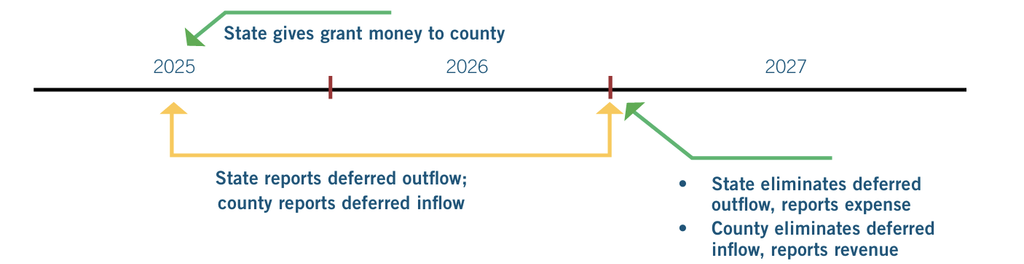
- A deferred outflow of resources is an outflow of resources that has occurred but is related to a future period, rather than the current period; therefore, a government postpones reporting it as an expense until that future period (i.e., the government defers it).
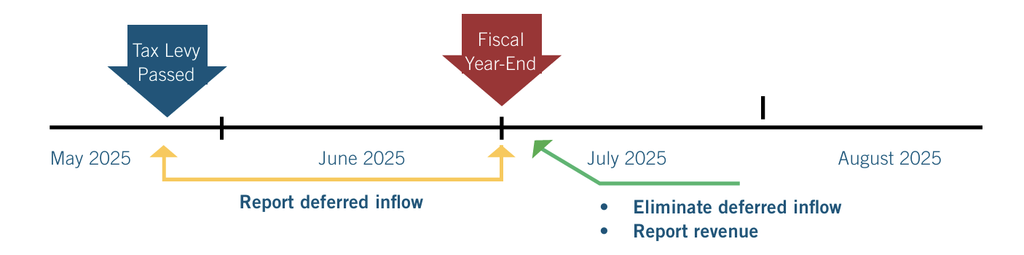
- A deferred inflow of resources is an inflow of resources that has occurred but is related to a future period, rather than the current period; therefore, a government postpones reporting it as revenue until that future period.
One source of the confusion surrounding deferrals is their names, which suggest that the outflows and inflows of resources will occur later. But, as the preceding definitions say, the flows have already happened — it is the reporting of them as expense and revenue that will occur later.
The vast majority of a government’s inflows and outflows of resources in any given year are related to that year, and therefore, the government reports them in the statements of resource flows as revenues and expenses. However, suppose a government receives an inflow of resources from a local business (such as cash or an account receivable) during the year, but those resources are related to a future year. In that case, the government reports a deferred inflow of resources in its statements of financial position until that future year arrives, at which time it reports the inflow as revenue.
Where Did Deferrals Come From?
In the early 2000s, the GASB was working on definitions for the items reported in statements of financial position. As expected, it found assets and liabilities:
- An asset is a resource that (1) a government controls at present and (2) has service capacity the government can use to provide service (e.g., a school building) or to support the provision of service (e.g., an office building that houses executive staff), or it can invest or sell the asset to produce income that pays for services.
- A liability is an amount a government owes at present to another entity or individual, and it is certain or close to certain that the government must meet that obligation.
The GASB also found items in those financial statements that don’t meet the definition of an asset or a liability. They don’t have service capacity that can be used to provide service or to support the provision of service, and they can’t be invested or sold. They also don’t represent an amount that a government must pay to another party or satisfy by other means. Most of those items being reported as assets and liabilities were the things we now call deferrals. (Some of those items met the definition of a current-period inflow or outflow, such as the costs related to issuing debt, and are now reported as revenue or expense.)
Deferrals look a lot like the items that are reported in the statements of resource flows:
- An outflow of resources is a using up of a government’s net assets (assets minus liabilities) that relates to the current period. These are generally reported as expenses or losses in the financial statements.
- An inflow of resources is an acquisition of net assets that relates to the current period. These are generally reported as revenues or gains in the financial statements.
The key difference between an outflow reported as an expense and one reported as a deferral is that the former relates to the current period, and the latter applies to a future period (at which time it will become an expense). Likewise, the key difference between an inflow reported as a revenue and one reported as a deferral is that the former relates to the current period, and the latter to a future period (at which time it will become a revenue).
The GASB published its definitions in Concepts Statement No. 4, Elements of Financial Statements, in 2007. The next year, it issued Statement No. 53, Accounting and Financial Reporting for Derivative Instruments, the first pronouncement that required the reporting of deferrals. In 2010, the GASB issued Statement No. 60, Accounting and Financial Reporting for Service Concession Arrangements, which also required deferrals.
Governments preparing to implement those statements faced a dilemma: The GASB’s standards did not address how deferrals should be displayed on the face of the financial statements or disclosed in notes to financial statements. Furthermore, the items that the GASB identified as deferrals when developing Concepts Statement 4 were still being reported as assets and liabilities.
How Should Deferrals Be Reported?
The GASB dealt with how to display and disclose deferrals in Statement No. 63, Financial Reporting of Deferred Outflows of Resources, Deferred Inflows of Resources, and Net Position:
- Governments are required to present deferred outflows separately after the assets. There must be separate totals for assets and deferred outflows.
- Governments are required to present deferred inflows separately after the liabilities. There must be separate totals for liabilities and deferred inflows.
Prior to Statement 63, governments reported the difference between assets and liabilities as net assets. However, when deferrals are added to the equation, the remaining amount reported is called net position (comparable to equity in corporate financial statements, but a government is not owned in the way that a company is).
A government’s statement of net position is arranged like the following equation:
(Assets + deferred outflows) – (Liabilities + deferred inflows) = Net position
In the governmental funds balance sheet, which employs modified accrual accounting, the equation is:
(Assets + deferred outflows) = (Liabilities + deferred inflows) + Fund balance
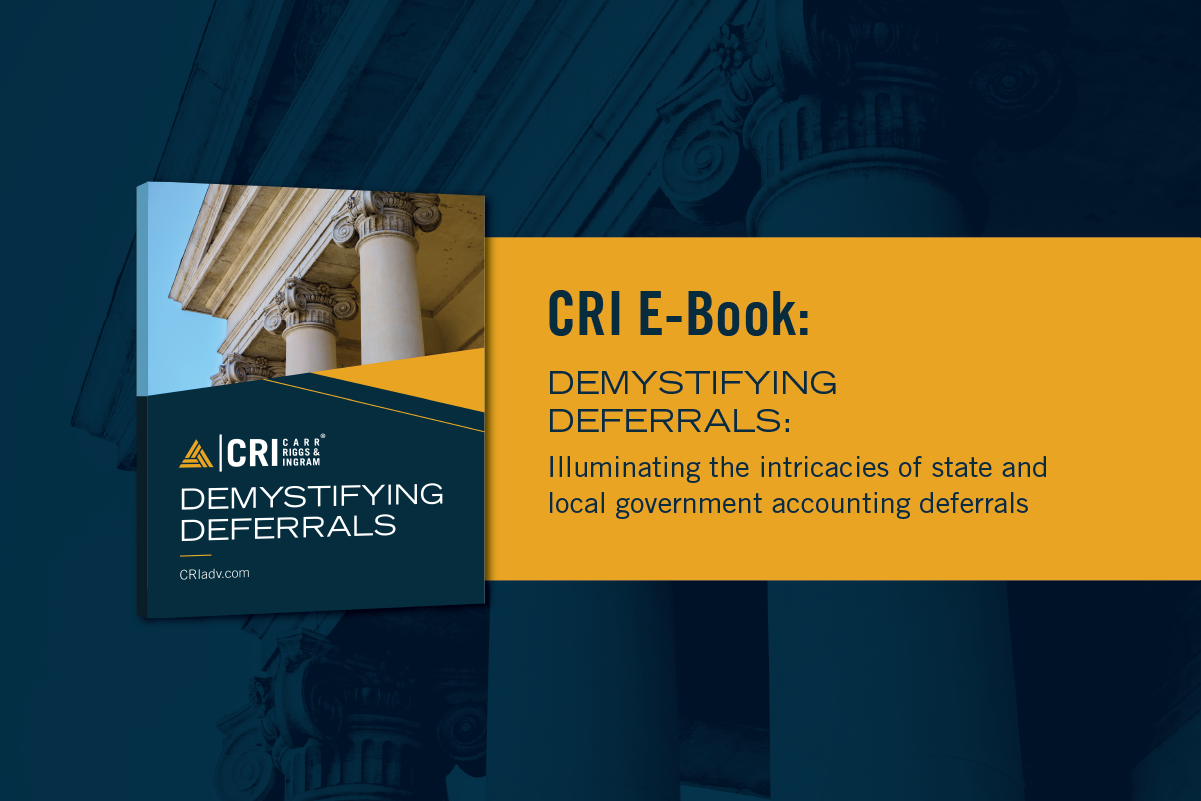
Governments are required to report their deferrals by type. Governments disaggregate deferrals and list them by type either (1) on the face of the financial statements, or (2) in notes to financial statements. For examples of both of these approaches, see our e-book Demystifying Deferrals.
Why Are Deferrals Important?
There are similarities between the reasons why governments prepare audited financial statements for public consumption and why corporations and NFPs do, but some of them are unique to governments.
First, it is important to governments to accurately measure the cost of providing services. Consider the following:
- Many federal and state grants are awarded based on the costs incurred to provide specific services, such as free or reduced-price meals in schools or health care provided to persons living in poverty. This makes accurate cost reporting crucial.
- Obtaining disaster relief funding from the federal government is based on documenting the cost of recovery. During the COVID-19 pandemic, for example, entities were expected to produce reports that documented how they used hundreds of billions of dollars of federal relief funds.
- Because governments are largely funded by taxes (which are not provided willingly) and grants (which the providing government also pays for with taxes), there is a need to be accountable to taxpayers and grantors for the efficiency with which tax and grant dollars are used to provide services. Efficiency is typically evaluated as the cost per unit of service, such as cost per student or cost per lane mile of highways paved.
- Measuring service costs accurately using the same approach across governments and over time enables comparisons that inform the degree of efficiency (“Is the government more or less efficient than other governments? Is efficiency improving or deteriorating?”) and program choices (“Which method of providing service produces the best quantity and quality for the money available?”).
For these reasons, it is important to ensure that expenses are accurately stated. Deferrals ensure costs are recognized as expenses in the proper periods, which helps to keep expenses from being overstated or understated in any given year.
Second, governments are expected to be accountable for making ends meet, year in and year out. In other words, governments need to demonstrate that they have raised sufficient revenue each year to cover expenses instead of draining savings or pushing costs off to future taxpayers. The GASB refers to that concept as interperiod equity. A unique objective of governmental accounting and financial reporting is to provide financial statement readers with information that allows them to assess interperiod equity. Deferrals assist with that assessment by ensuring that revenues and expenses are reported in the proper periods and not overstated or understated.
How Do Deferrals Clarify Government Finances?
In summary, deferrals contribute to the information value of government financial statements by postponing the reporting of revenues and expenses until the appropriate period (or, in some cases, ensuring that certain inflows and outflows of resources are never reported as revenues and expenses) and by reporting revenues and expenses in the correct amounts.
Reporting deferrals in government financial statements is a win-win; they provide potentially valuable information in a way that does not diminish the value of other information. The reader of the financial statements does not need to conduct a deferral hunt because governments are required to separate them in the financial statements. If one chose to ignore deferrals, one would still be able to use all of the other information for one’s desired purpose. However, ignoring deferrals and the messages they communicate about a government’s finances may deprive the user of valuable insights.
Want More Information?
The full version of this article with many more examples of commonly reported deferrals, can be found in CRI’s Demystifying Deferrals e-book, which contains additional articles that address the issue at different depths for a variety of stakeholders, as well as links to short videos and other resources. As always, your CRI advisor is available to answer your specific questions about deferrals.