Deferred Outflows and Deferred Inflows of Resources in a Nutshell
- Contributor
- Dean Michael Mead
Sep 8, 2026
Government finance operates under a unique set of principles and practices distinct from those in the private sector. One aspect of governmental accounting is particularly bewildering: deferred outflows of resources and deferred inflows of resources (referred to together as deferrals). The mere mention of “deferrals” seems to create a fog that envelops the minds of many — including experienced and knowledgeable auditors, government finance officers, and municipal bond analysts.
Part of the confusion surrounding deferrals stems from the name given to them by the Governmental Accounting Standards Board (GASB), the organization that establishes accounting and financial reporting rules for U.S. governments below the federal level. The names deferred outflows of resources and deferred inflows of resources suggest that the flow of resources into a government (such as cash receipts or accounts receivable) and out of a government (such as cash payments and accounts payable) will not happen until sometime in the future. But that is not the case.
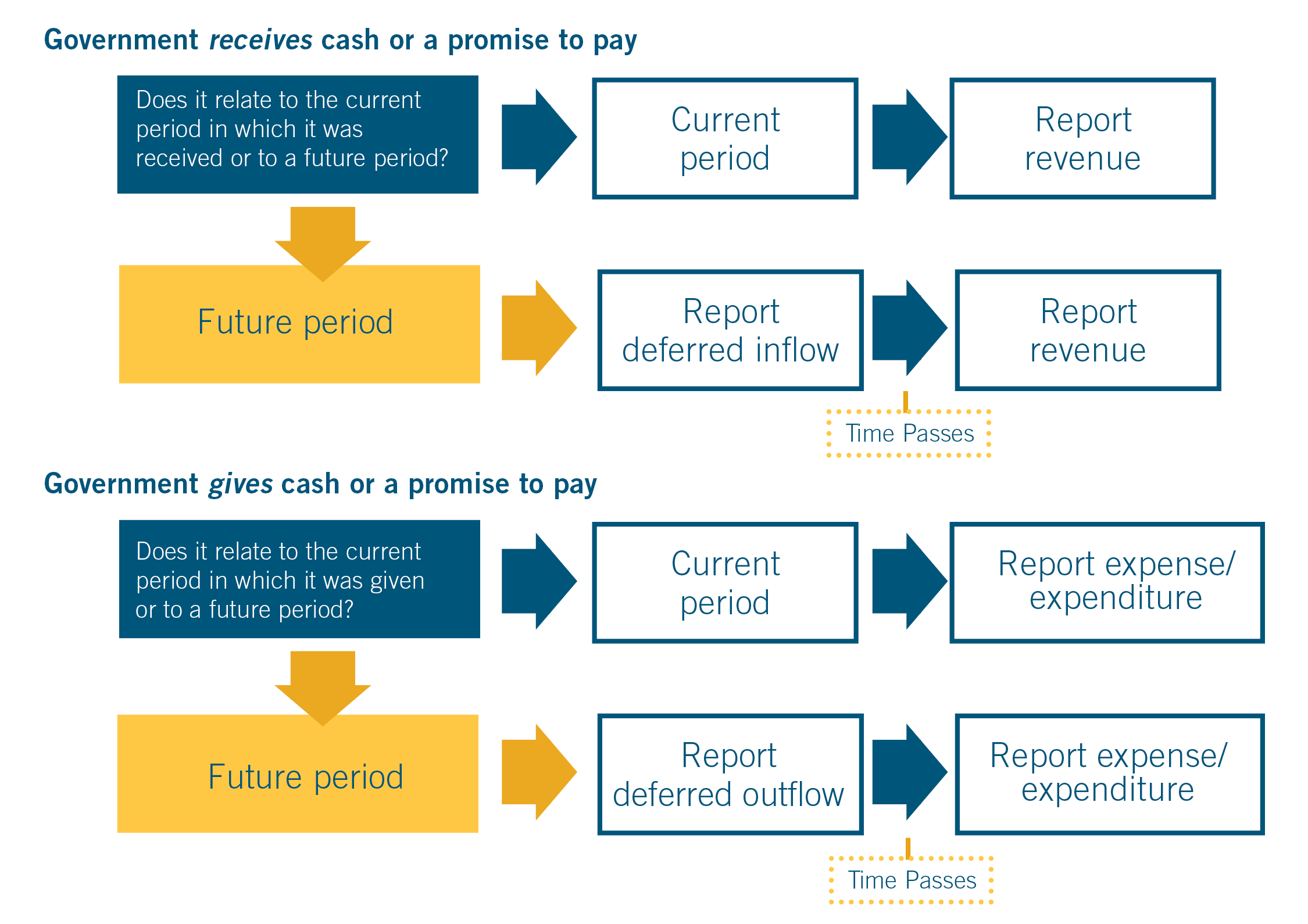
When a government receives resources, it generally reports revenue in its income statement. When it provides resources, it generally reports expenses (or expenditures in its governmental funds). Occasionally, however, the resources a government receives or provides during the year are related to a future period. As a result, the government defers reporting revenues or expenses until that future period arrives. In other words, despite their name, deferred outflows and deferred inflows are not postponements of outflows and inflows of resources, but rather, postponements of reporting them as expenses and revenues, respectively.
Common Examples of Deferrals
Property Taxes
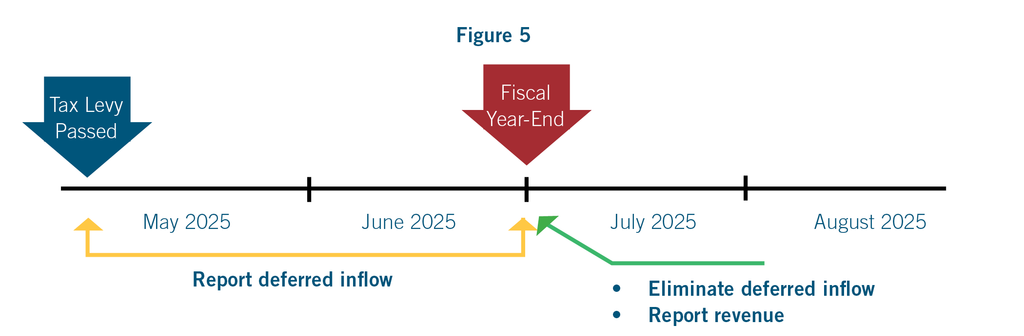
Consider a city with a fiscal year that ends on June 30. Each May, it adopts a budget and levies property taxes for the next fiscal year, starting July 1. Often, a government is legally entitled to property tax payments as soon as it levies the tax; GASB rules say that when a government is legally entitled to property tax payments, it should report the new property taxes it is owed as a receivable and revenue. However, in this case, the new property taxes are levied for the next fiscal year. Reporting them as revenue in the current year would overstate this year’s revenue and understate next year’s revenue.
Because those new property taxes are related to next year, the government should temporarily report them as a deferred inflow in its balance sheets. Then, when the next fiscal year begins on July 1, the government removes the deferred inflow and reports the property tax revenue in its income statements.
Government Grants
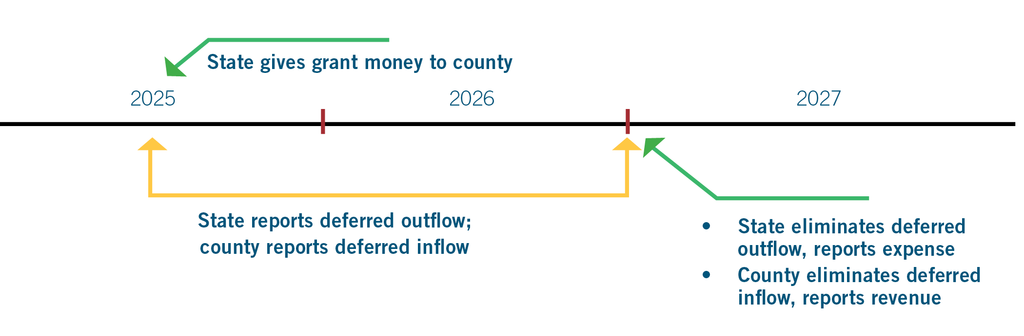
Another common example of a deferral relates to government grants with time restrictions. Most grants from the federal and state governments are not received until the grant recipient has met the grant program’s eligibility requirements — usually by spending money on a specific service or program, such as policing or free school lunches — and subsequently applied for reimbursement. Imagine, though, that a county receives a state government grant in 2025 that it is not allowed to spend until 2027. If that grant has no eligibility requirements (or the county has already met the eligibility requirements), all the county has to do is wait until the time restriction expires before spending the money. The county temporarily reports the grant money received as a deferred inflow; when 2027 arrives, the county eliminates the deferral and reports the grant as revenue.
Consider the same example, but from the perspective of the state providing the time-restricted grant. Until 2027, the state reports the grant payment as a deferred outflow. When 2027 begins, the state eliminates the deferral and reports the grant as expense. That is essentially the mirror image of the way the county accounts for the transaction.
Why Deferrals Are Important
As those examples illustrate, deferrals can be used to ensure that governments report revenues and expenses in the proper years. That helps to meet an important objective of governmental financial statements — to provide the public with information for assessing interperiod equity. Stated differently, a reader of government financial statements should be able to tell whether a government is living within its means each year. There is a general expectation that governments should not spend more each year than they take in.
There are sometimes good reasons to pay for something over time. It may make sense for a government to take out a loan to purchase new vehicles; since they will be used to provide services for several years, paying for them over several years may be financially prudent. However, a government cannot routinely spend more than its income on recurring annual costs of operating and providing services without exhausting its savings, pushing today’s costs onto future taxpayers, or accelerating future income to the present. All of those actions would deepen the government’s financial problems.
In this regard, government finances are much like personal finances. If a person earns $40,000 annually after taxes but spends $50,000, how do they pay for the $10,000 above and beyond their earnings? If they have savings, they might withdraw from their account. Or they might borrow the money by using a credit card. Neither option is limitless; eventually, the savings account will be emptied, and the credit card will be maxed out. Furthermore, using up savings and borrowing increase one’s cost of living because of the lost interest income on the savings and the interest charges on the outstanding credit card balance.
Reporting deferrals helps ensure that the appropriate revenues and expenses are reported each year, enabling the most accurate assessment of whether a government has balanced its checkbook, so to speak.
Want to Learn More about Deferrals?
Reach out to your CRI advisor to address your specific questions about deferrals. We also invite you to take a deeper dive into the topic through our Demystifying Deferrals e-book, which contains additional articles that address the issue at different depths for a variety of stakeholders, as well as links to short videos and other resources.